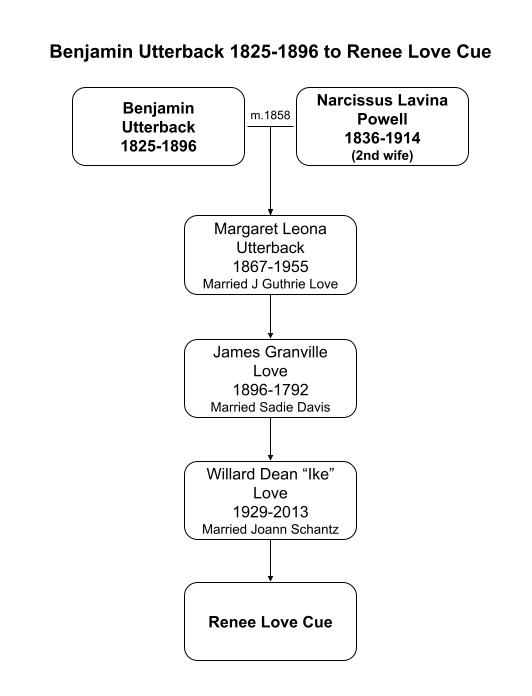
If you are related to Renee via her father, Willard “Ike” Love, you might have heard talk of the Utterback Family. Ike’s grandmother was Margaret Leona Utterback (1867-1955), known as Leona. Leona is our most recent connection to the Utterback surname; she married James Guthrie Love in 1894.
Our Utterback ancestors (known in Germany as “Otterbach”) first arrived in Virginia in the early 1700’s. The Utterback family tree is huge; we have countless cousins. This post is specific to Leona’s father, Benjamin Utterback (1825-1896). Benjamin, born in Kentucky, served as Private in the Mexican-American War in 1847.
The Mexican-American War 1846-1848
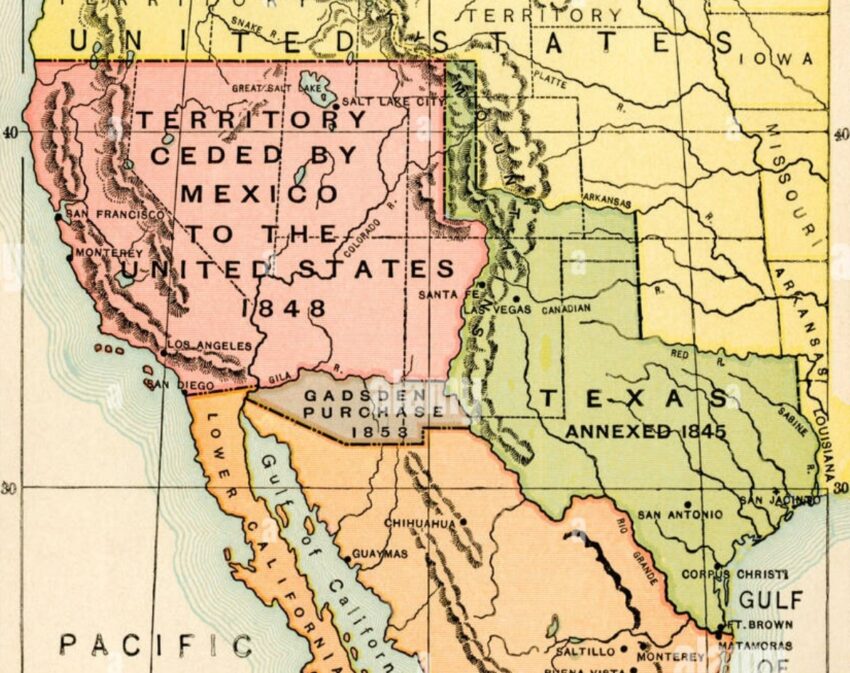
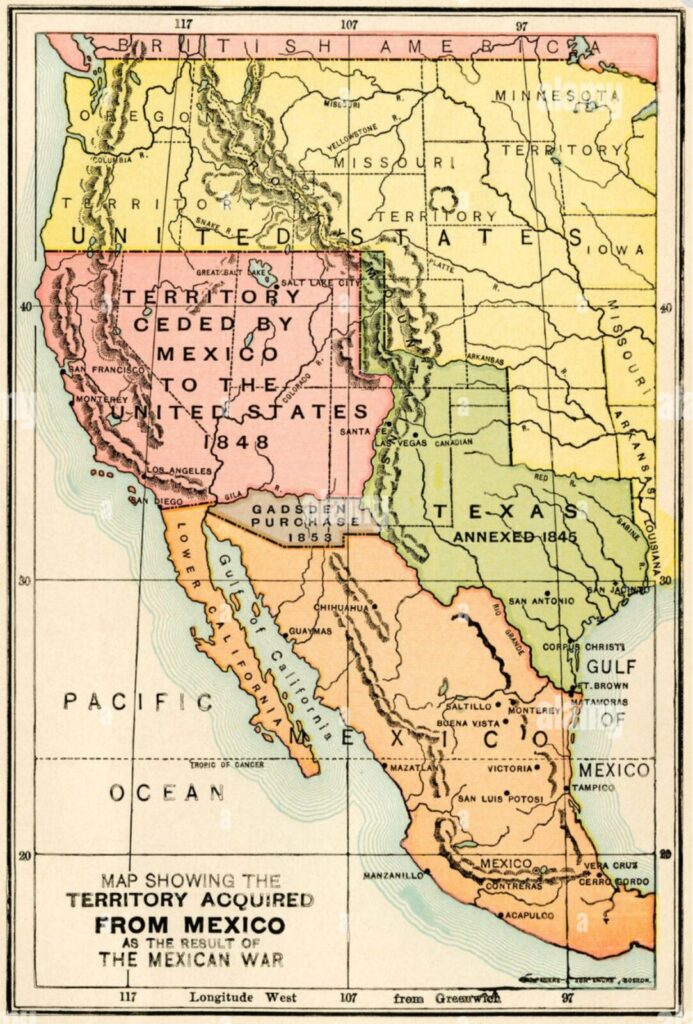
The Mexican-American War was also known as “Mr. Polk’s War” back in the day. It was named for President James Polk, the aggressor. The war began an invasion by the US into Mexico to claim territory west of Texas and expand the US to the Pacific. In 1845, prior to the war, the Republic of Texas had been annexed into the US by treaty, despite threats from Mexico because of a disputed border. President Polk had offered $25 million to buy the territory in question and all of the land from Texas to California. This effort to claim the southwest from Mexico had begun decades earlier when President Andrew Jackson tried to acquire the territory in 1825. Mexico said, “No, Thank You.”
“Manifest Destiny” is the term for the expansionist belief that white European-American settlers were destined to expand westward across North America. Polk had won the presidency with a platform of growing the US by any means. Despite the popular sentiment of a US that stretched to the Pacific, the war was not without controversy. The issue of slavery was hurtling the US toward the Civil War. Northern states were concerned that admitting new southern states would upset the balance of slave-holding vs free states. Nevertheless, the idea of the nation stretching from the Atlantic to the Pacific was appealing to a patriotic populace. As a result, Polk had support when he declared war on Mexico on 13 May 1846.
The US dominated the war and emerged victorious. In 1848, the Treaty of Guadalupe Hildago ended the war with Mexico and ceded vast amounts of territory to the US. In Texas, the Rio Grande was agreed upon as the US Mexico border.
Private Benjamin Utterback of the Kentucky Third Regiment Volunteers
Benjamin entered into his military service as a Private at Louisville, Kentucky as part of Captain William E Simms’s Company in the Third Regiment, Kentucky Volunteers. The regiment went to New Orleans, then on to Vera Cruz, Mexico, and, finally, Mexico City.
Why would a young man from Kentucky join the army and march off to the Southwest? Army recruitment posters urged patriotic men to join up. The effort was successful but conditions were rough for the 90,000 men who enlisted. Wages were low and the march was long. Battle deaths amounted to only 1.5% of the troops (1,721) but death from disease and other non-combat issues claimed over 10% of the troops (11,155).
However, an attraction to join the army were land bounties for the returning soldiers. As the sixth child and fourth son of a dozen children, Benjamin was not likely to come into an inheritance of land. Enlisting in the military provided a young, single man an opportunity for an adventure, fame, and fortune. Although he came from a large family, Benjamin was the only one of the brothers to go to the war. After the war, he returned safely to Louisville where he mustered out in 1848.
In 1937, William Irvin Utterback published The History and Genealogy of the Utterback Family in America, 1622-1937. The author included a delightful profile of Benjamin’s military service including selections from letters he wrote while serving in the Mexican-American War. My favorite excerpts include: ”I am not dead yet.” and “I may marry here for there are some of the prettiest girls here that I ever saw in my life. but I think that a Kentucky wife would be best. Mary (his favorite sister), tell the girls not to marry before I return.”
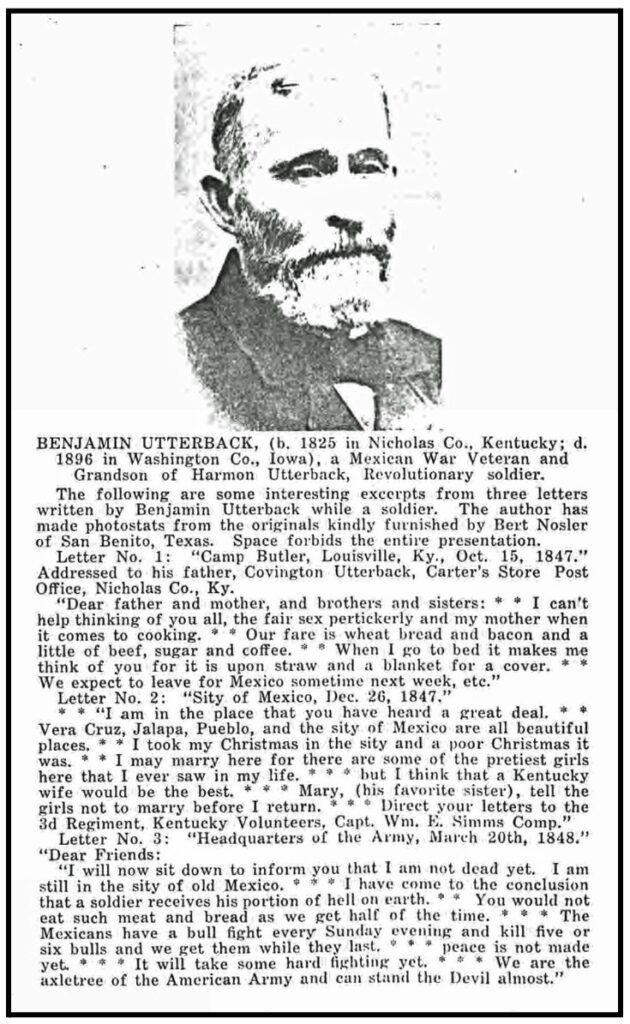
Once finished with his service, Benjamin applied for and was granted a land warrant for 160 acres of land in Kankakee, Illinois. As was common, Benjamin chose not to move to Illinois. He sold his land warrant to a land speculator, Orson Beebe. In 1851, Benjamin married his first wife, Eleanor Bryan (1828-1855). Eleanor died after the birth of their two daughters. Benjamin moved with his children to Boone County, Indiana where his older sister Elizabeth “Lizzie” (Utterback) Moore and her family had relocated.
Once in Indiana, he married Narcissus Lavina Powell (1836-1914) in 1858 (she went by Lavina). The growing family moved to rural Ainsworth, Washington County, Iowa around 1865. In addition to the daughters from his first marriage, Benjamin and Lavina had seven more children. My great-grandmother Leona (Utterback) Love was their first child born in Iowa.
Benjamin was granted a pension in 1888 for his military service and, after his death, 1896, his widow Lavina, was granted a widow’s pension. Benjamin and Lavina were buried at the Ainsworth Cemetery in Ainsworth, Iowa. If you are passing through, stop by and place a pretty stone on their grave for me.
Learn more about the Utterback family:
The History and Genealogy of the Utterback Family in America, 1622-1937
You can find the Utterback Genealogy at the FamilySearch library. While the book is an amazing effort, as is common in many early genealogies, a few misattributions and mistakes have been identified.
Link to the digital version: https://www.familysearch.org/library/books/viewer/162912/?offset=1&return=1#page=1&viewer=picture&o=info&n=0&q=
Learn more about the Mexican-American War:
National Park Service: The Mexican-American War
https://www.nps.gov/places/the-mexican-american-war.htm
The Mexican American War | History In A Nutshell
If you would like more information or need detail about my sources, please contact me at reneecue@gmail.com.