A Little Background….
In 1898, a sensational scandal captivated newspapers across the entire country for months. In San Francisco, Mrs. Cordelia (Brown) Botkin was accused, tried, and convicted of mailing poisoned candy to the wife of her lover, John P Dunning. Dunning and Mrs. Botkin had an affair over the course of the 1890’s. At first, the affair was clandestine but then Mrs. Mary (Pennington) Dunning chose to move with their daughter to Mrs. Pennington’s father’s house in Dover, Delaware. After that time, Dunning and Mrs. Botkin maintained a public relationship out and about, visiting the races and restaurants. In 1898, Dunning accepted a new job and plainly admitted to Mrs. Botkin that he was leaving, never to return and would be uniting with his wife in Delaware. “He turned a deaf ear to her (Mrs. Botkin’s) pleadings and told her bluntly that he would never return to San Francisco.”
Mrs. Botkin was hurt and angry. In a mad attempt to get rid of her rival, Mrs. Botkin mailed a box of poisoned candy to Mrs. John P Dunning on 9 August 1898. When Mrs. Dunning received the box, she shared the candy with her sister, their children, and two friends who happened by. The arsenic-laced candy sickened them all; Mrs. Dunning and her sister died within a few days.
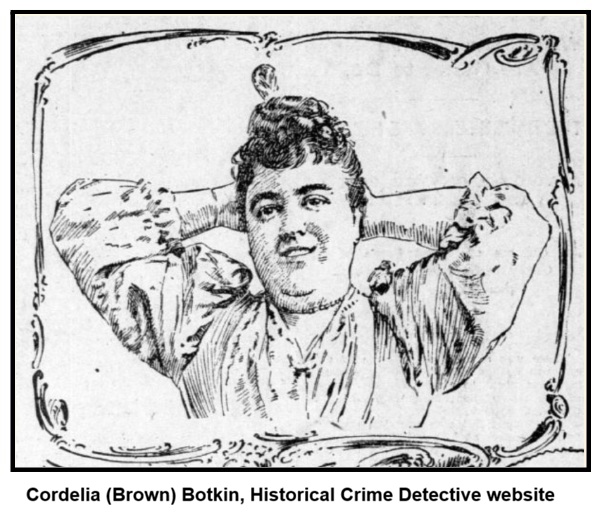
The motive was straight-forward. Mrs. Botkin expected to step in and regain the affection of Mr. Dunning once his wife was out of the picture.
What does this have to do with our Cue family? Based on a similar event in 1904, newspapers across the nation proclaimed “Iowa Has a Botkin Case.”
Belle Martha Cue in Iowa’s Own Botkin Case!
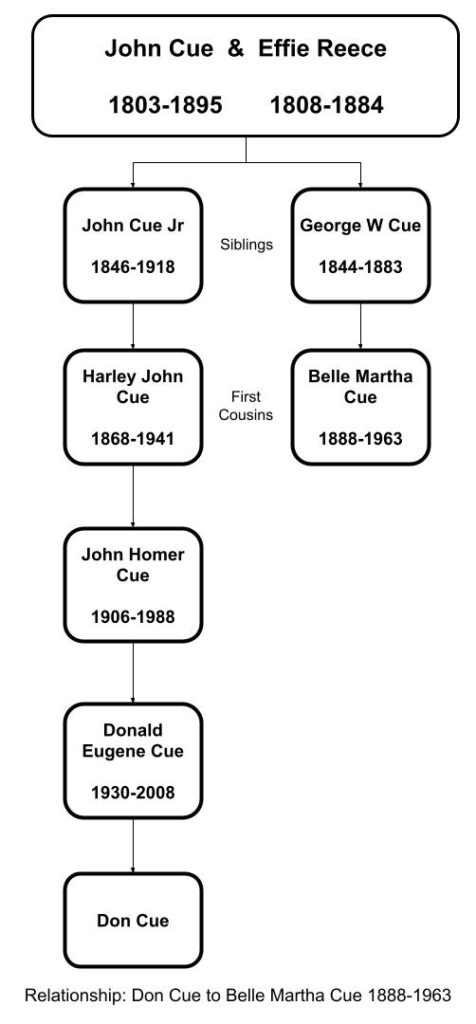
Belle Martha Cue, the daughter of George and Eliza (Gardner) Cue and granddaughter of John and Effie (Reece) Cue, was born in Linn County, Iowa on 4 August 1868. Belle grew up in Linn County and, at age 22, married a local man, William Sherman Dye, known as Sherman. Sherman pursued a career with the burgeoning railroads as a “Telegrapher.” Telegraphers sent and received messages using the dots and dashes of Morse code. By 1900, the young couple, along with their daughter Beatrice Olive, moved to Boone, Iowa. Sherman had secured a job with the Chicago North Western Railway in Boone, Iowa, a major Iowa hub for the railway.
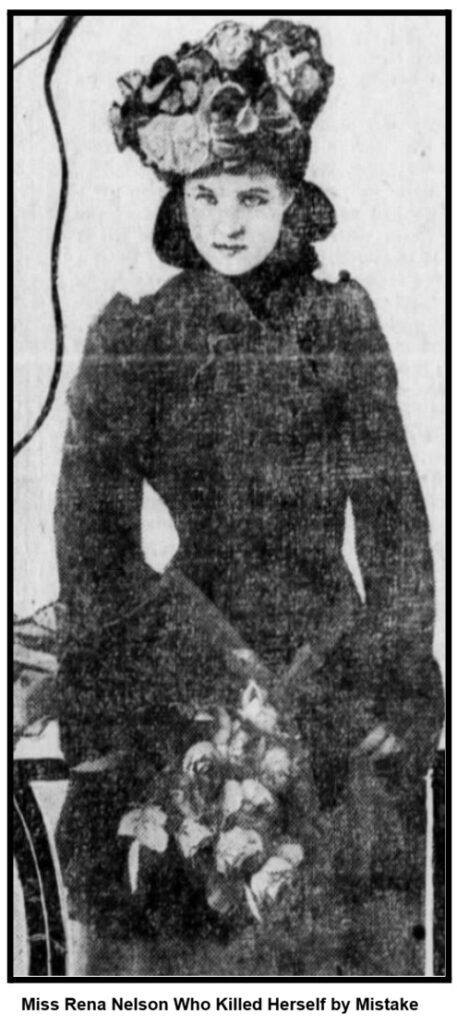
At this same time, Miss Rena Nelson from Pierre, South Dakota moved to the Boone area in 1900 where she had a large number of aunts, uncles, and cousins. Rena got a job as a telephone operator. The telephone operators, in addition to manually connecting local calls, also worked with the railroads for urgent dispatches. The job of telegrapher was reserved for men while telephone operator became, primarily, reserved for women.
Belle and Sherman were experiencing a troubled time in their marriage. By her own account, Belle noted that her health had been bad and she feared she had neglected Sherman. Sherman and Rena began a relationship. Sherman gained the admiration and affection of Rena and the two became intimate. The affair was interrupted when Rena moved back to South Dakota in the fall of 1902. Rena came back to Iowa, however, to visit in the summer of 1903. She and Sherman once again became friendly. Rena claimed that Sherman led her to believe he was divorced and available for her affections. Sherman and Rena became “engaged,” unbeknownst to his wife.
In the fall of 1903, Rena returned to her mother and step-father in South Dakota. She and Sherman developed a steady correspondence. In Boone, Belle was growing suspicious; Sherman was spending a great deal of time in some secretive endeavor in the chicken coop. He avoided her inquiries about what was taking so much of his attention.
A month later, Belle intercepted a letter and package of handkerchiefs intended for Sherman from Rena. The letter made it clear that Rena and Sherman were engaged in a serious romantic relationship. Belle confronted Sherman. He agreed to drop his relationship and correspondence with Rena. Sherman wrote to Rena telling her she had lost his affection and he was breaking off their tete-a-tete.
Rena wrote pleading letters to Sherman espousing her love for him and asking him to reconsider. Belle took it upon herself to persuade Miss Nelson to end her romantic pursuit. In January 1904, Belle sent letters to Rena instructing her to stop sending letters to her husband.
The whole matter took an extremely dark turn at the end of February 1904. On 27 February, Rena went to the post office at Pierre with her stepfather where she received a letter and a box of candy. The box appeared to have been posted in Boone, Iowa. Rena was delighted with the gift and ate the candies, even mentioning that one of them tasted off.
Rena became very ill. She wrote a letter to her aunt explaining about the box of candy she had received, her relationship with Sherman, and proclaimed he had always acted as a gentleman. Rena placed the blame on Belle. The letters she had received from Belle were characterized as threatening. The investigation in South Dakota included an analysis by Professor Whitehead of the State Agricultural college who confirmed that the candy had been poisoned. Belle was arrested and charged with attempted murder. Despite her protestation of innocence, she was jailed in Boone. Meanwhile, Sherman stood by Belle, even physically staying with her in jail.
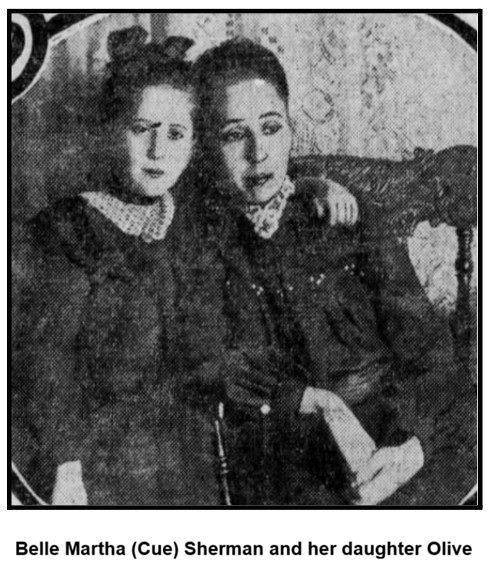
New Twists and Turns Emerge
The courts in South Dakota moved to extradite Belle to stand trial. Meanwhile, Rena continued to go downhill. She suffered in intense agony and, after ten days, Rena died on 8 March. “The autopsy showed that the lining of her stomach had been literally eaten away, while nearly all the important organs had been so affected as to make death a certainty.” The charge was updated to murder.
In Iowa, a new twist emerged. On 10 March, Belle was released on a legal technicality. Iowa Governor Cummins, after consulting with the state attorney general, ruled that Iowa law did not allow for Belle’s extradition. The legal ruling was based on the fact that Belle could not be claimed to be a “fugitive from justice;” she had never been in South Dakota. This was the first case of this kind to come up in Iowa. The governor alerted the legislature that the attorney general was preparing a bill to repair the defect in the law.
Meanwhile, further investigation continued in South Dakota. Things were not adding up. Looking into the details of the events, such as the packaging of the contaminated candy, the South Dakota investigator could see from the envelope and the postmark that the box was not a part of the original postage. The method for the postmark on a letter was different from that of a package. Belle had indeed sent letters to Rena; when confronted with the accusation of murder she “readily admitted writing letters urging Miss Nelson to cease interfering between man and wife.”
In addition, it was evident that the address had been pasted on the package with a postmark of January 1 while the package was not received until 27 February. Where was the package purchased? An owner of a local Pierre candy shop recognized Rena as stopping in his shop searching for a specific type of candy and box before the poisoning occurred. The Hughes County, South Dakota county attorney searched the Pierre candy shops and found that on 26 February, Dahoff & Co. confectioners had sold Miss Rena Nelson the chocolate drops. The paper in which the box of poison candy was wrapped was identical with that used by Dahoff & Co.
And then there was the letter Rena wrote to her aunt on the day that Rena claimed to have received the candy. So much detail, much like a confession or a set-up. The Attorney General donned the poisoning an unintentional suicide. Rena had underestimated the deadliness of the drug.
Belle was no longer a suspect. Having been freed after the extradition legal decision, now Belle was completely in the clear.
The scandal made headlines across the country. The story had taken the United States and Canada by storm, reaching newspapers from sea to shining sea in March and April of 1904. While the news in the local Iowa papers stuck to the facts, the San Francisco Chronicle and the San Francisco Examiner knew the value of a sensational story and full page coverage. Not surprisingly, the Dye family moved on from Boone and relocated and settled in Arapahoe County, Colorado. Sherman continued to work as a telegrapher for the railroads.
Belle and Sherman had been married for sixty years when Sherman died in 1951 at the age of eighty-two. Belle passed away on 4 January 1963 at the age of ninety-five in Arapahoe County. Their daughter, Beatrice Olive, married Karl Luke. The couple had two children and remained in Colorado throughout their lives.
If there is a moral to this sordid tale, it is this: Do your research if you are trying to frame someone for attempted murder. Love-struck Rena was hoping for sympathy, rescue, and a loving reunion with her paramour but, instead, suffered horribly and ultimately succumbed to the poison.
Learn more details about Belle Martha Cue and this case or the 1898 Cordelia Botkin Case:
“Iowa Has a Botkin Case,” San Francisco Examiner, 3 April 1904, Page 3
“Mrs. S. Dye Under Arrest,” Boone County Republican, 10 March 1904, Page 8
“Candy From a Stranger: The Cordelia Botkin Case of 1898,” Historical Crime Detective, Photo of Mrs. Cordelia Botkin; historicalcrimedetective.com
If you would like more information or need details about my sources, please contact me at renee@reneecue.com.